“In the best-case scenario, we are in a time of transition. In the worst-case scenario, what we see is a downfall,” the British curator and author Charles Esche said of the current state of the Venice Biennale. Esche’s remark came during a round table discussion at the activist centre Sale Docks in Venice last week, arranged in cooperation with Institute of Radical Imagination. Apparently also meant as a more general comment on the state of the world, his words do make a lot of sense to me after experiencing the 61st Venice Biennale during the preview week. I am left with a strong sense of a need for fundamental changes, paired with an equally strong suspicion that the Biennale machinery will just keep on going like before, whatever resistance it faces from artists, cultural workers, or art critics.
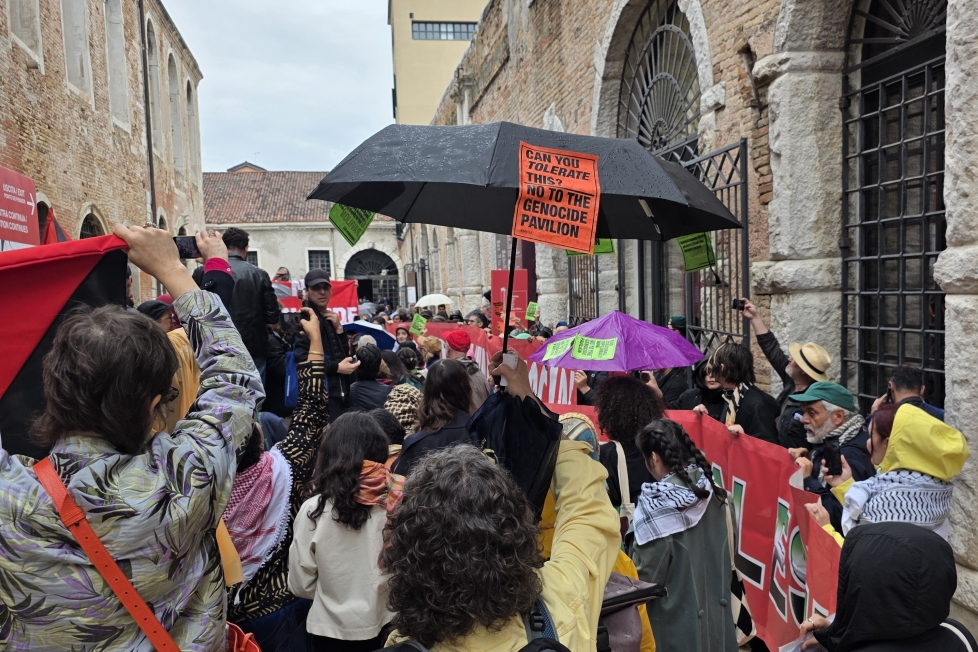
This year, there have been escalating protests against the national participation of Israel and Russia, with several campaigns against both countries ahead of the opening. The EU has reacted to Russia’s participation by cutting economic support for the Biennale, and even the Italian minister of culture has expressed dismay and boycotted the opening. During the preview days, the Russian dissident punk group Pussy Riot staged several actions against the Russian pavilion; the Baltic pavilions arranged a demonstration in solidarity with Ukraine; and ANGA – Art Not Genocide Alliance – managed to close down the Israeli pavilion for a couple of hours with demonstrations outside the exhibition space, which is now not to be found in the Israeli pavilion in the Giardini, but in a more secluded space in the Arsenale.

It all climaxed on 8 May, the day before the Biennale was due to open for the general public, when ANGA gathered more than three thousand people in solidarity with Palestine, a demonstration that was stopped by police in riot gear outside the Arsenale. On the same day, the group arranged a large strike – apparently the first at the Biennale since 1968 – where 27 national pavilions and several other artists and culture workers kept their exhibitions closed, some for the whole day, others for a few hours. Among the pavilions on strike were some of this year’s most popular exhibitions, if you are to judge by the length of the queues, like Austria, the Netherlands, France, and Japan. Disappointingly, the only Nordic countries to participate in the strike were Finland and Iceland; the Danish and Nordic pavilions kept their doors open.
There is also controversy around the Biennale prize, the Golden Lion. Initially, the jury declared that they would not consider any countries under investigation by ICC (the International Criminal Court) – that is, Israel and Russia – for the prize. After facing a certain amount of backlash, the entire jury resigned, and the Biennale administration announced that they would instead award a visitors’ prize on the last day of the Biennale, 22 November. The latest development in this case is that approximately half of the artists in the main exhibition In Minor Keys, and several teams affiliated with national pavilions, have withdrawn from consideration for this new prize.
Personally, I boycotted the pavilions of Israel, Russia, and the MAGA-sanctioned USA pavilion; thus, I have nothing to say about their artistic content. Apart from that, I walked around for four intense and blister-inducing days in the narrow streets of Venice, in an attempt to see as many of this year’s 99 national pavilions as possible.
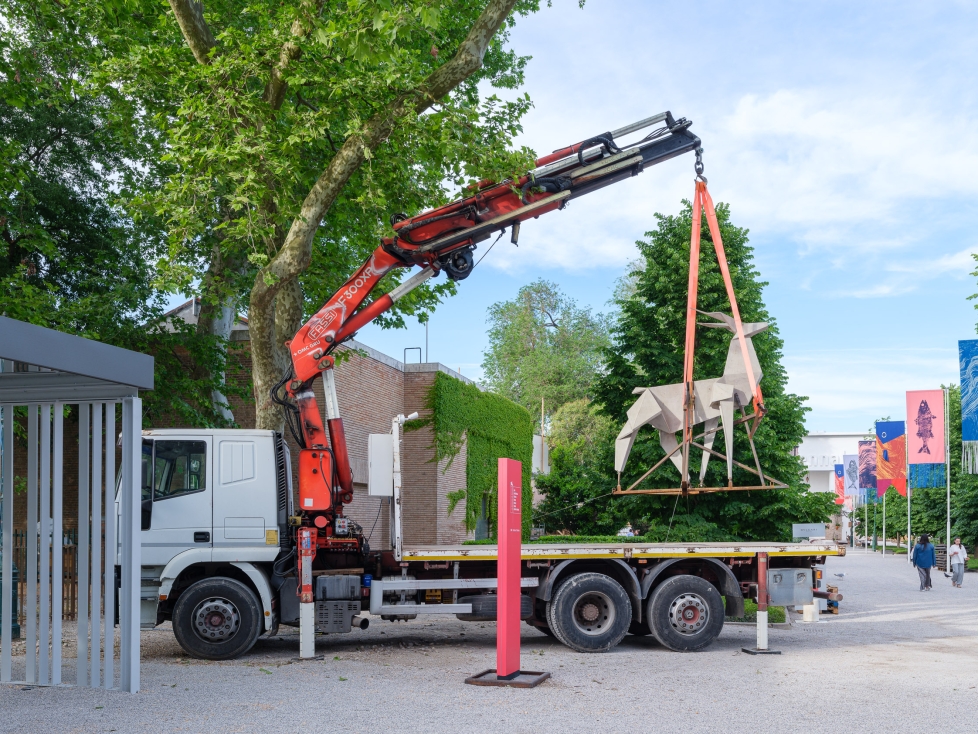
While Palestine, as always, is only represented in the Biennale’s collateral programme, with an exhibition that opened after I had left Venice, Ukraine is represented both in the Giardini and the Arsenale this year. In the Giardini, Zhanna Kadyrova’s sculpture The Origami Deer (2019) is suspended from a crane on a truck parked right inside the entrance to the park, and consequently not far from the Russian pavilion. In the Arsenale, a multi-channel video installation documents how the sculpture travelled from Ukraine to Venice, passing through several European countries. The sculpture was transported on an open truck, and the many different scenes showing the sculpture travelling with its head proudly lifted appear quite absurd and comical, despite the serious reason for its relocation. Kadyrova’s sculpture was initially created as a public work for a park in Pokrovsk but had to be moved when the Russian forces were approaching the town.
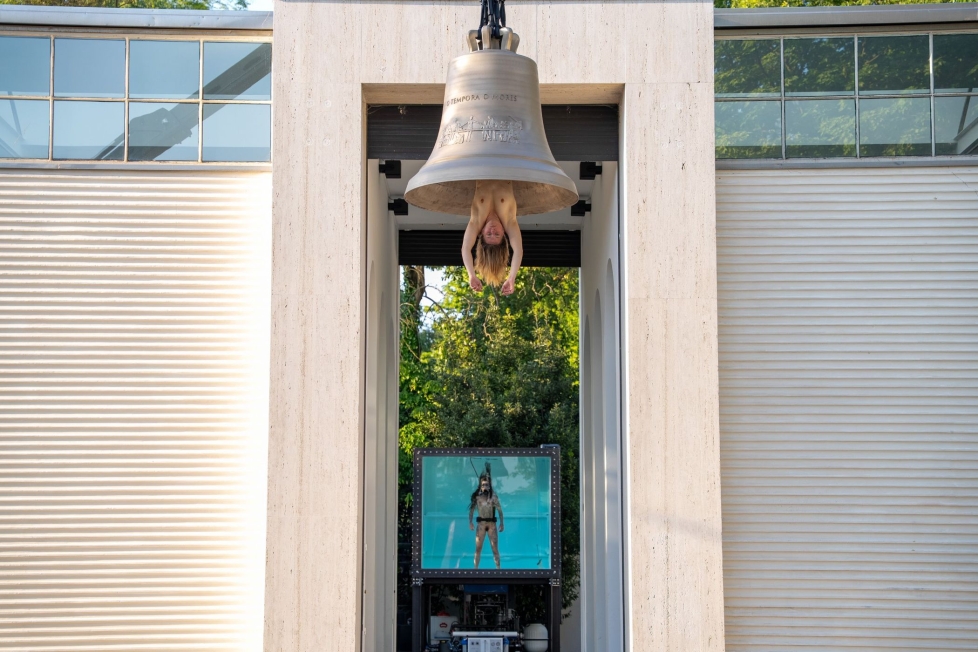
This year, there is one pavilion that everyone is talking about, and that will probably be discussed for years to come: the Austrian pavilion. Here, performance artist Florentina Holzinger has created Seaworld Venice, an excellent combination of a grotesque underwater park for adults and a nightmarish societal vision. “I live in your piss,” reads an inscription at the entrance. The exhibition’s concept is that visitors may contribute by using two portable toilets, from which their urine will be filtrated and used to deliver water to a universe populated by naked women climbing acrobatically in a large rotating weather vane, taking turns driving in circles on a jet ski, doing advanced yoga poses, and sitting underwater in an aquarium-like tank – while a couple of clothed women work as cleaners, fighting the dirt from the toilets and occasionally becoming overwhelmed by cascades of brown water from the filtration system.
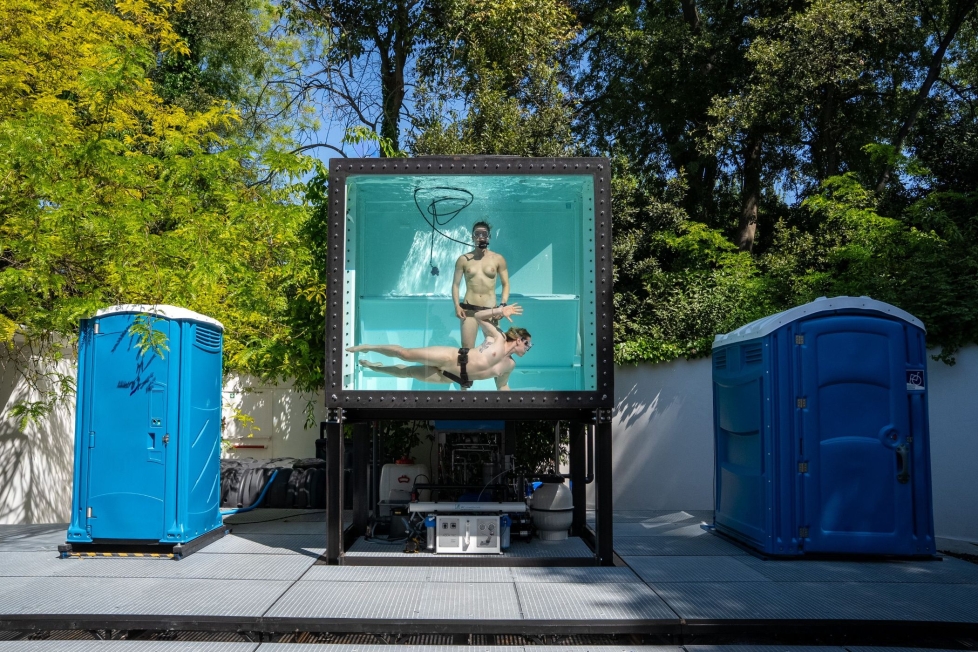
A large bell is suspended in front of the pavilion, and now and then one of the naked women climbs up and rings it – invitingly or alarmingly – by hanging upside-down inside and swinging sideways like a clapper. I can’t shake the feeling that there is an extra layer of irony in this work, as Holzinger gives a decadent art crowd everything their hearts could desire: transgression, provocation, spectacle, a kind of renewed Viennese Actionism, feminist, class-conscious, and ecologically aware societal criticism – and a couple of extra toilets in a Biennale area where such facilities are not abundant.
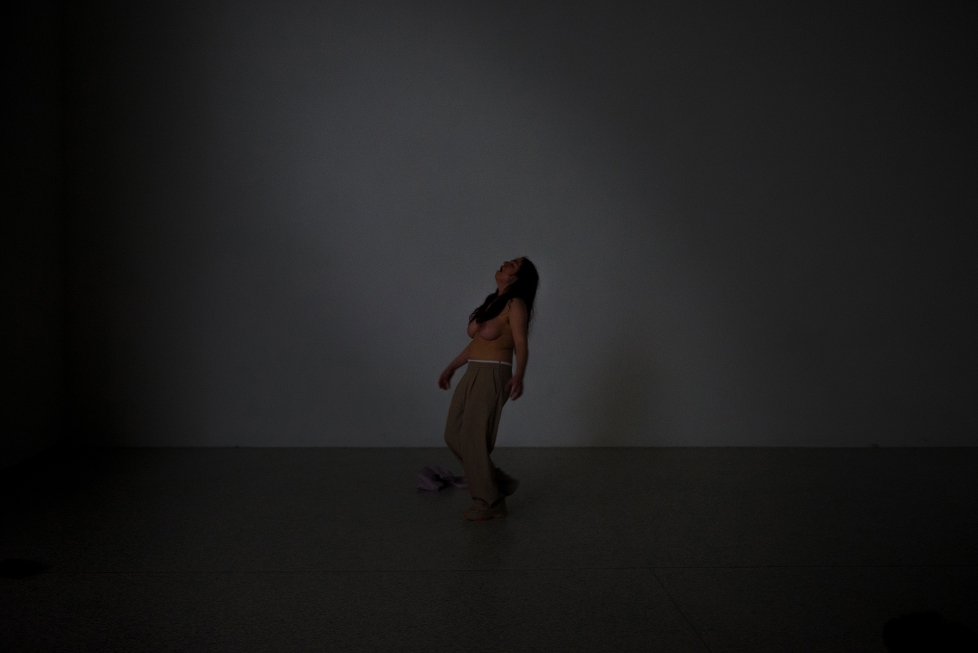
Several of this year’s strongest pavilions are performance-based. In Dries Verhoven’s Dutch pavilion, The Fortress, visitors are locked inside for half an hour, during which time they are at the mercy of one of thirteen contributing performance artists. When I was there, Diane Mahin moved around roaring with a guttural, demonic voice that seemed unlikely to be coming from the body of a young woman, while the room gradually darkened to black.
Mahin approached and at times leaned on the visitors. At one point, I had her right beside my left ear, roaring “Engage!” Whether it was an actual call to engage or simply satire is an open question, nevertheless, it was impossible not to be a little pushed off-balance by it. The lack of facial expressions, in combination with the violent voice, created a certain distance from the words she expressed, slowly and insistently, putting weight on every syllable: “love yourself,” “joy,” “enjoy it,” and other statements that could have been taken from a self-help book or a commercial.
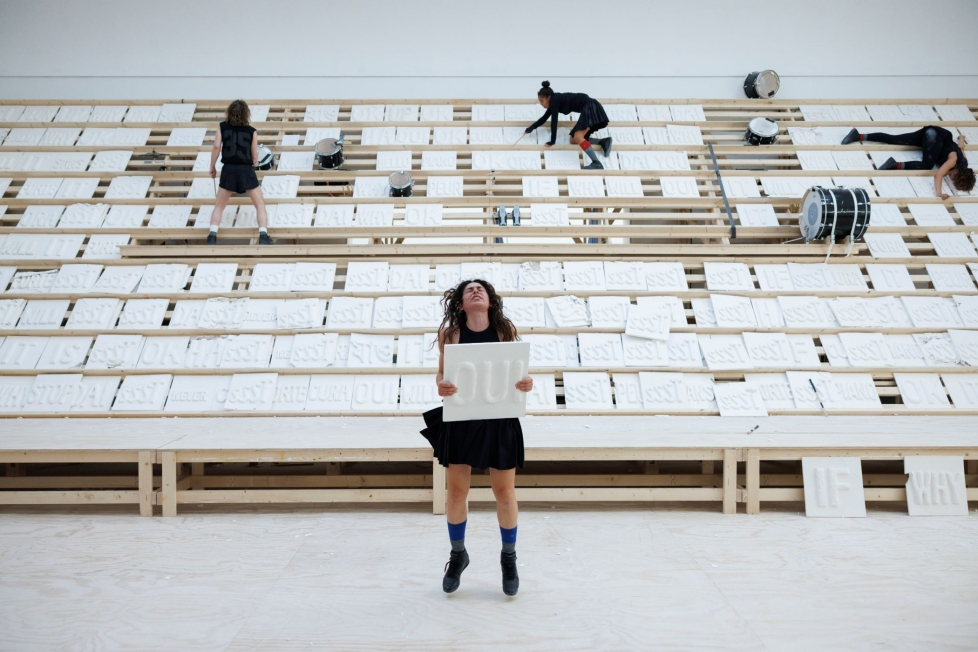
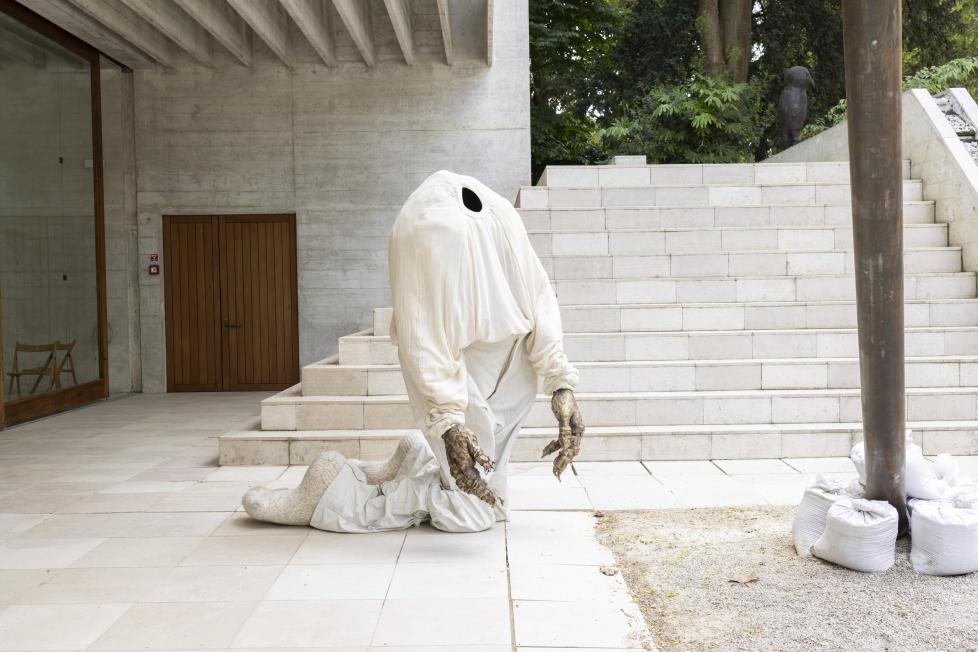
Norwegian artist Tori Wrånes’s performance on the opening day, in which she embodied a headless troll dragging its large feet behind it and singing plaintively from its zippers, as though from a hollowed vulva, elevated the Nordic pavilion, which shows an exhibition of fairy-tale-inspired sculptures by Wrånes, Swedish artist Klara Kristalova, and Finnish artist Benjamin Orlow. In the Belgian pavilion, Miet Warlop’s It Never Ssst regularly comes to life with a fiery musical performance, where a team of black-clad performers drum, sing, and throw around plaster words, in what seems to be an attempt to organise fragmented communication. Overall, this pavilion seems like a workshop and a place in process. When I was there, an artist was also working on a clay version of a portrait of one of the drummers.
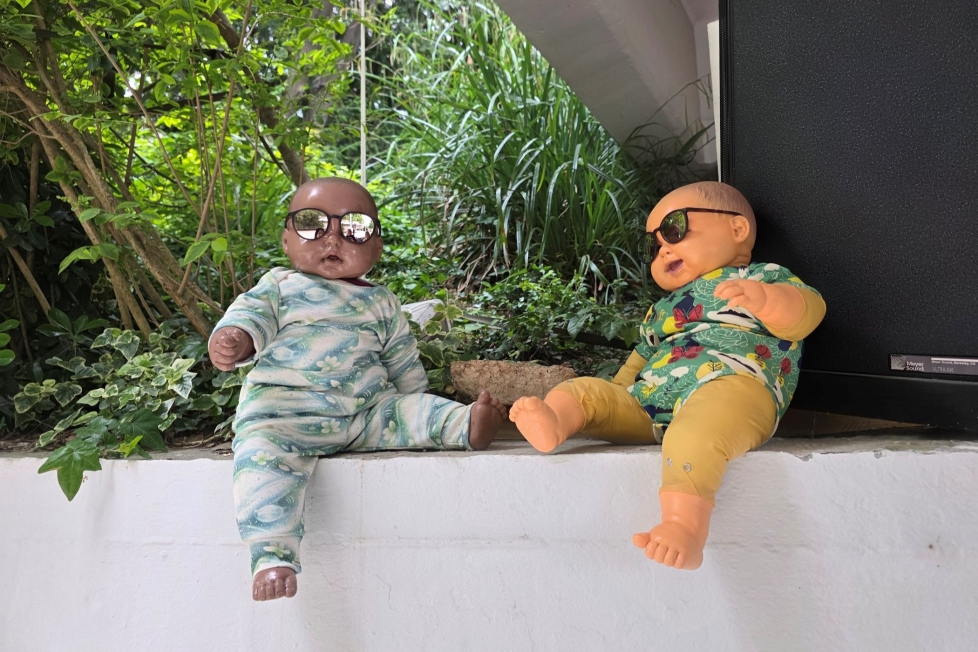
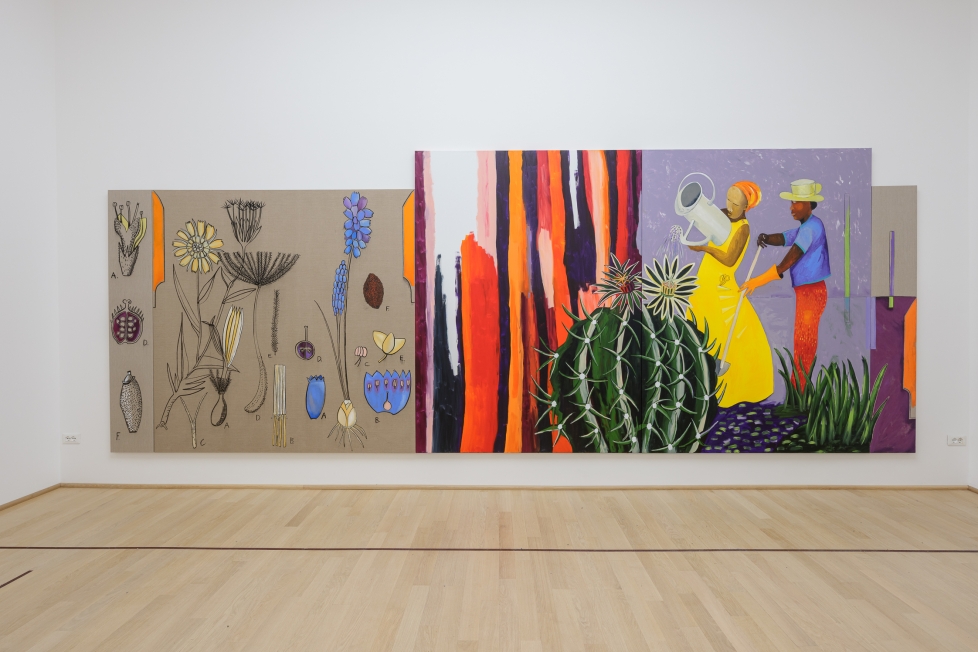
In a place like Venice, where there is literally art around every corner, it is easy to end up running too fast from one exhibition to the next without fully experiencing anything. Here you find everything from spectacular pavilions like Japan’s, where Ei Arakawa-Nash is showing an exhibition overflowing with baby dolls in cool sunglasses that visitors are invited to carry around, to the Spanish pavilion, where Oriol Vilanova has covered all of the venue’s walls with thousands of postcards, to the British pavilion, which is showing a more traditional exhibition of colourful scenes painted by Lubaina Himid, to Yto Barrada’s modernist exercises in the French pavilion, and the Slovenian pavilion, where the Nonument Group presents a sound installation in the ruins of a mosque – to mention but a few. You need to allow yourself to be carried along and to stay put in one place when it feels right.
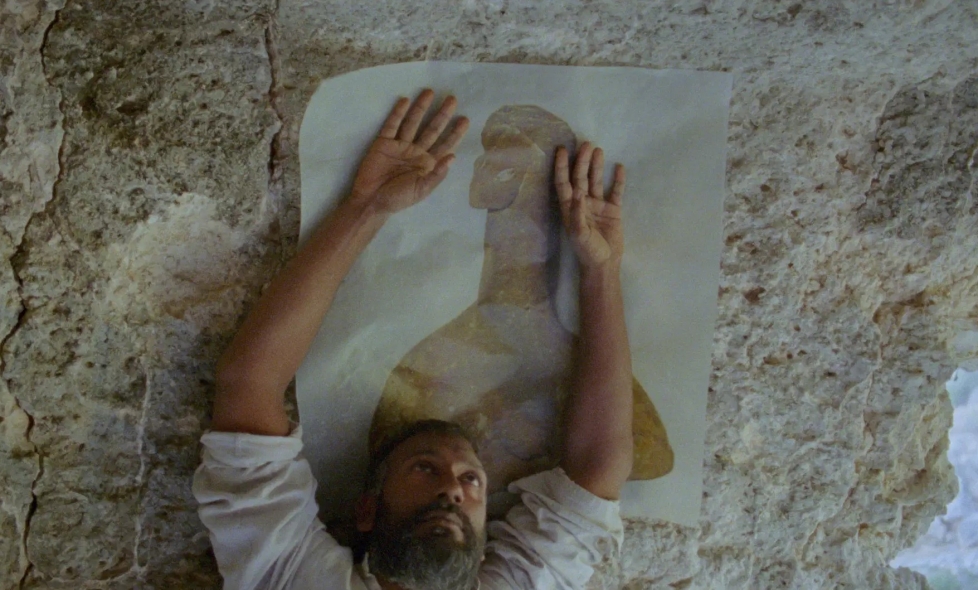
One of the exhibitions I spent a lot of time in, without planning to, was the Lithuanian pavilion, where a three-channel video by Eglė Budvytytė is on show. I was drawn in by the appealing soundtrack and the mystical spasms controlling the silent people in the film, who appear in groups but still seem isolated from each other. In animism sings anarchy, the connection between humanity’s earliest history and today’s highly technological reality – and the fact that we are still just shivering cave-dwellers in need of human intimacy – is thematised in a strange and suggestive manner.
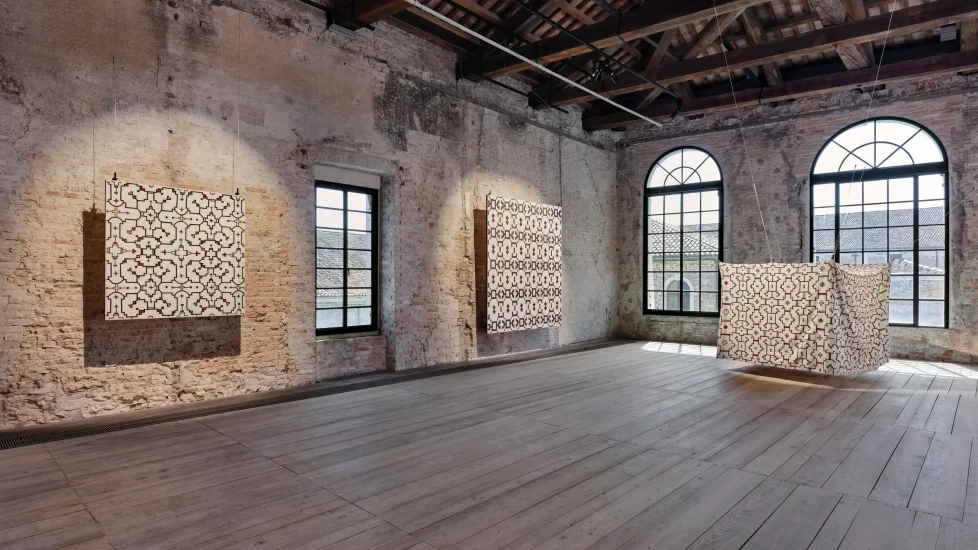
Another captivating exhibition is to be found in the Peruvian pavilion, which is showcasing an Indigenous artist for the first time. Sara Flores’s abstract paintings on cotton textiles feature different symmetric and repetitive patterns inspired by kené, a traditional design system developed by the Shipibo-Konibo people. In a video on a loop, such a patterned textile flies like a flag against a blue sky – a quiet protest or a celebration? In a chaotic and visually overstimulating world – and Biennale – Flores’s exhibition offered a contemplative, quiet space that I was not prepared for.
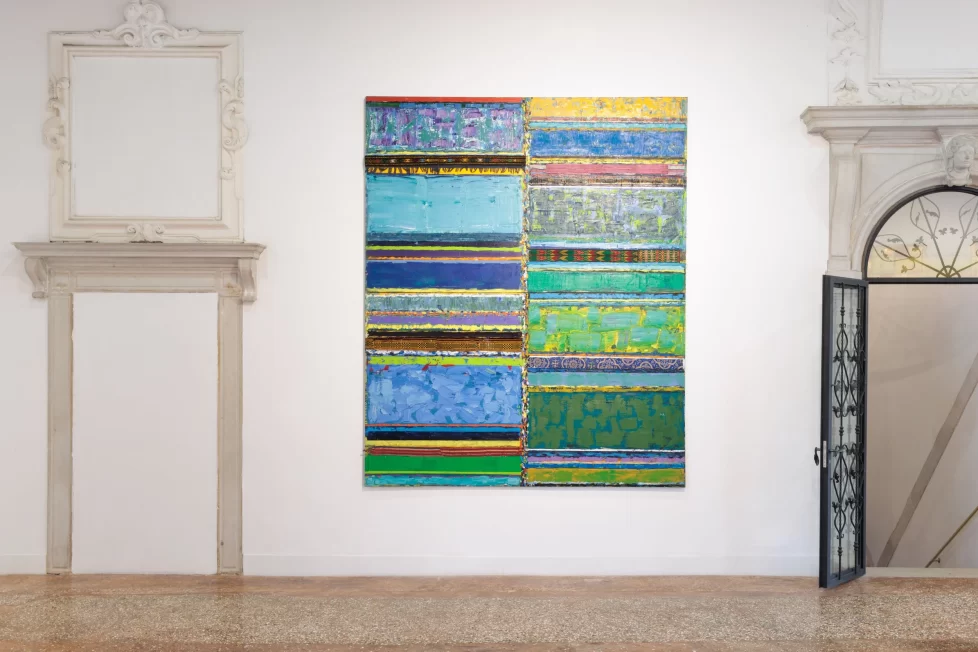
It is no exaggeration to say that there are some evident hierarchies in the structure of the national pavilions. Roughly speaking, the former colonial powers reside in the Giardini, while the other countries compete for venues in – or near – the Arsenale. For example, this year, Egypt and Morocco are the only African countries represented in the designated area of the Biennale, consequently benefiting from the concentration of visitors that this location brings. The rest of the participating African countries are scattered around the city. However, several of them have found great venues, like the Congo, which is showing a nicely curated group show titled Simba Moto! Seize the Fire! Saisis le Feu! in the beautiful thirteenth-century building Scuola Grande di San Marco, and Ethiopia, where artist Tegene Kumbi’s abstract, expressive pictures combining oil painting and textiles collected from different countries thrive in the light and spacious rooms of the Palazzo Bollani.
Somalia was not as lucky in the cramped Palazzo Caboto, and this created a bit of trouble during the opening performance, where there was not nearly enough space for everyone that wanted to see it. But with a location near the Arsenale, with a view of the canal, the country is still among the more privileged, and when the Somali minister of culture opened the first-ever Somali pavilion, there seemed to be no bad vibes. The group exhibition Saddexleey, titled after a Somali triadic form of poetry, consists of paintings by Somali Swedish artist Ayan Farah, a video installation by Somali Danish artist Asmaa Jama, and a room filled by poignant poems about diasporic life by Somali British poet Warsan Shire. However, the fact that none of these artists are based in Somalia has been met with criticism from artists based in the country, who argue that the pavilion is not representative of the Somali art scene.
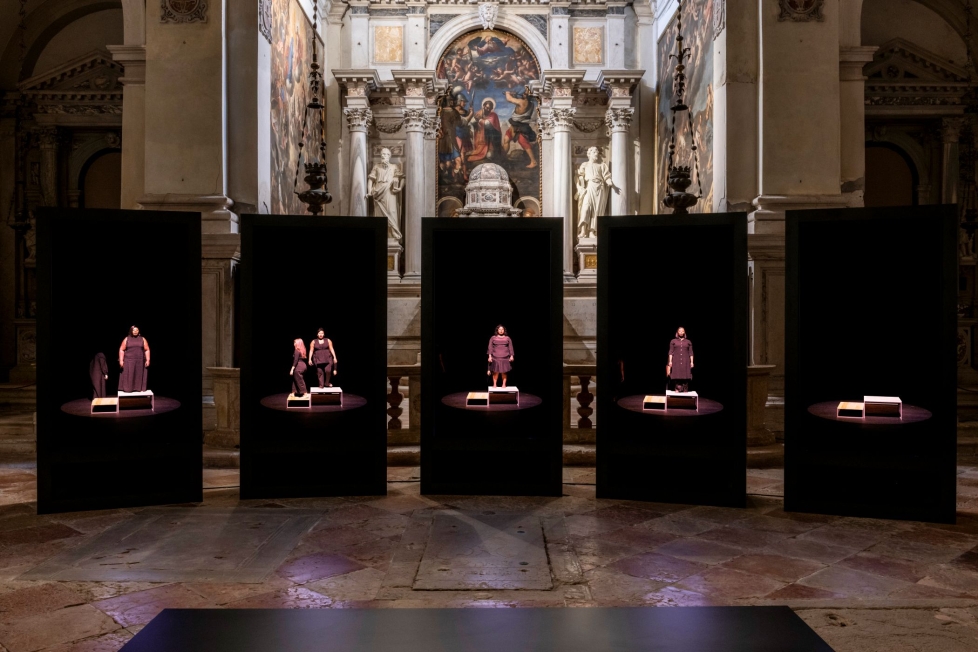
The exhibition I personally appreciated the most was Gabrielle Goliath’s Elegy, which, to be fair, was not really part of the official Biennale programme because the South African minister of culture cancelled it due to the artist’s references to the genocide in Palestine. That is entirely South Africa’s loss, though, and not Goliath’s. With its great acoustics and sacred atmosphere, the church room in the Chiesa di Sant’Antonin provides a perfect setting for her work and the exhibition is better suited to being independent than to being placed within the national frame of the South African pavilion.
Elegy is an ongoing “life-work” of mourning that Goliath started in 2015 as a reaction to a wave of femicide in her home country. The installation in Venice consists of three parts: a video with a recreated version of the first elegy, dedicated to Ipeleng Christine Moholane, who was killed in Johannesburg in 2014 when she was 19 years old; a two-channel video titled Elegy for two ancestors, mourning two unidentified women killed by the German colonial power during the Ovaherero and Nama genocide in present-day Namibia between 1904 and 1908; and a new five-channel video, Elegy for a poet, mourning the Palestinian poet Heba Abunada, who was killed with her son in an Israeli bombing in Khan Younis, Gaza in October 2023. In these three works, which merge into a greater unity in the exhibition, a stream of black-clad women climb, one by one, a small podium where they sing a single note until they are out of breath and are replaced by the next woman in line. But one of the screens dedicated to Abunada shows a podium that remains empty, visualising the enormous absence that the genocide leaves behind.
Although it is obvious, given how the Biennale is structured today, to demand that Palestine should be recognised as a state and be given its own pavilion, the fundamental problems of the Biennale will not be solved by admitting more participating nations. The Biennale is not only problematic for an already overloaded city. It is also problematic for art and for artistic freedom to have to work within such a system, where artists are asked to represent more or less corrupt nation states and nationalistic ideologies.
The current structure of the Biennale, with pavilions acting like embassies that the participating nations can use to promote their agendas, was established in the 1930s under the fascist rule of Mussolini and has long been ripe for the scrap heap. To decolonise the Biennale would mean giving the Giardini back to the Venetians, rather than letting Qatar build a new pavilion in the middle of the park – which is what will happen after this year, when the wealthy dictatorship participated for the first time with a temporary pavilion and a donation of EUR 50 million. The Venice Biennale should not grow larger; it should be reduced and made more sustainable. As it is today, it is already far too big for human bodies and souls to digest.